Carbon Neutral Field
- HOME
- Business Information
- R&D Department
- Carbon Neutral Field
- Synthesis technology for
visible-light-driven hollow
photocatalyst capsules
(stratified photocatalyst) - Carbon dioxide recycling:
Contributing to a carbon-neutral
society through the development
of new processes
Synthesis technology for visible-light-driven hollow photocatalyst capsules (stratified photocatalyst)
Highly active, visible-light-driven cadmium sulfide photocatalyst for applications in emissions control and hydrogen generation.
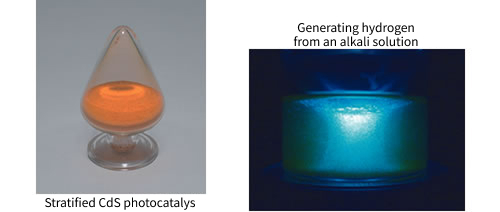
Semiconductor particles are arranged into a unique hollow capsule (stratified structure) that significantly enhances their photocatalytic properties.
Outline of technique
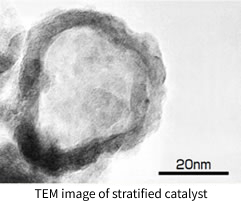
Cadmium sulfide (CdS) particles are arranged into nano-capsules, creating visible-light-driven semiconductor photocatalyst particles that offer dramatically improved hydrogen generation efficiency compared to previous catalysts. These stratified catalyst particles function as photocatalysts when placed in an alkali solution with dissolved hydrogen sulfide, offering extremely efficient hydrogen sulfide decomposition and hydrogen generation. Potential applications are in controlling hydrogen sulfide emissions from factories and generating hydrogen.
Features
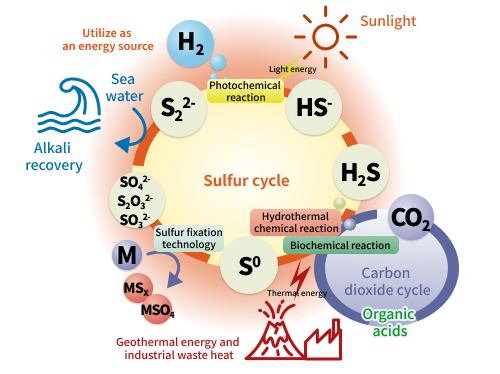
Catalyzes the decomposition of hydrogen sulfide and generation of hydrogen through a sunlight-driven photocatalytic reaction.
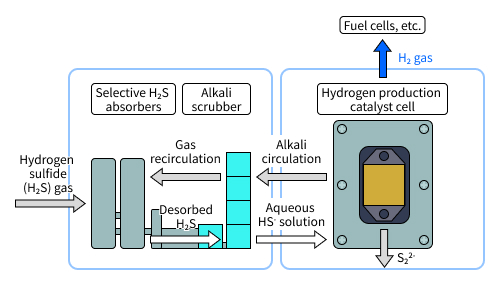
Example application: Hydrogen production by hydrogen sulfide decomposition
Hydrogen sulfide gas is generated as an unwanted byproduct in oil refineries, geothermal power plants, sewage treatment plants, and other facilities. These facilities expend substantial energy (thermal and electrical) processing and detoxifying these hydrogen sulfide emissions and recovering sulfide as a byproduct, primarily through an oxidation process.
Stratified CdS photocatalyst particles can decompose hydrogen sulfide using just sunlight, a natural energy source, while also producing hydrogen (a next-generation energy source) in a groundbreaking new treatment process.
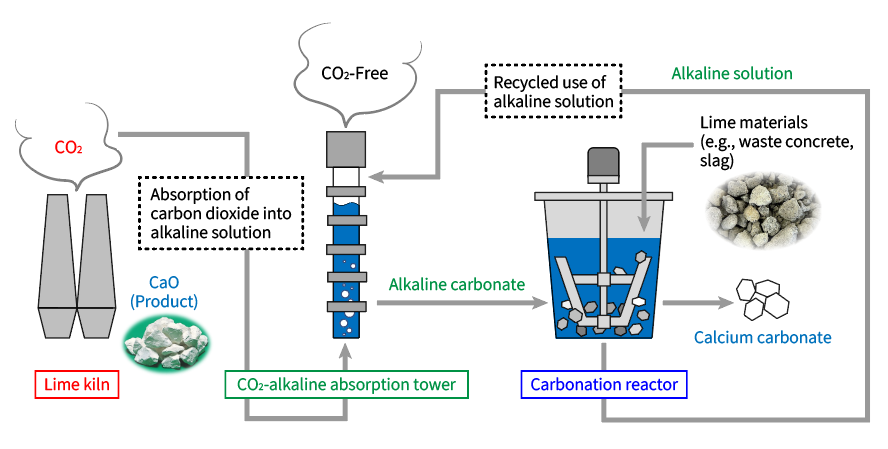
Carbon dioxide recycling: Contributing to a carbon-neutral society through the development of new processes
One of the key initiatives for achieving carbon neutrality by 2050 is carbon recycling technology. As the name implies, carbon recycling involves converting CO2 into fuel or materials for reuse, circulating CO2 throughout society to prevent the generation of new emissions.
Leveraging our extensive knowledge of limestone, we are developing technology to mineralize CO2 exhausted by lime kilns and other sources into calcium carbonate. This technology uses waste materials such as discarded concrete and slag as raw materials and recycles chemical solutions, creating a resource- and energy-efficient process.